

The Tech Event Bubble: Business, Posturing, and Expo Saturation
Read the original in Spanish →
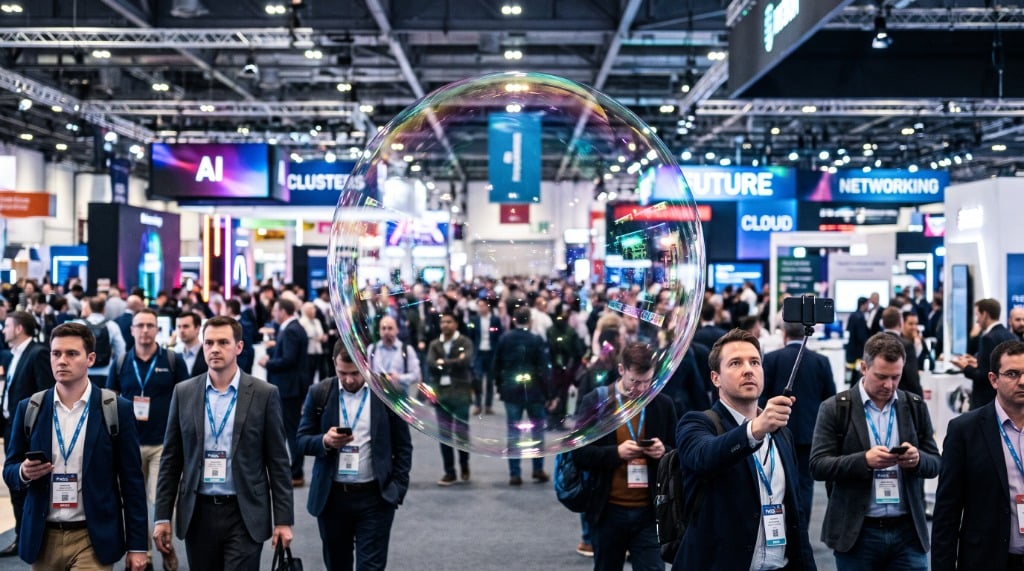
Open LinkedIn on any given Monday morning. Within the first three scrolls, you will run into two “unmissable” congresses, three “exclusive” executive breakfasts, two industry trade shows, and an endless parade of lanyard photos proudly resting against watery catering coffee.
If you are a CISO, IT director, or technical lead, and you decided to attend everything you are aggressively invited to—promising to solve the latest security crisis or handing you a cured ham in exchange for enduring a fifteen-minute demo—your workday would simply vanish. You wouldn’t have time to handle a single incident, audit an access policy, or manage your team. You would spend your entire life inside a convention hall.
The sheer volume of tech and cybersecurity events has completely jumped the shark. Nobody dares say it out loud for fear of making organizers or sponsors uncomfortable, but the question is glaring: do we really need this insane volume of trade shows, or have we built a wheel that only turns to feed itself?
1. Groundhog Day for tech content
If you have attended three events over the last six months, feeling trapped in a time loop is unavoidable:
- Photocopied themes: “Zero Trust in the Age of AI,” “The Challenge of the NIS2 Directive,” or “How Observability Will Save Your Infrastructure.” Three or four buzzwords shuffled in different permutations depending on the season.
- Permanent speaker rotation: The exact same faces hopping from stage to stage every week, often delivering the very same slide deck with nothing changed except the date on the title slide.
- The sponsor trap: Twenty-minute sessions billed as practical case studies that, right around minute seven, devolve into a shameless product pitch.
Real technical knowledge—the kind forged by troubleshooting production outages, wrestling with legacy architectures, and owning complex problems—doesn’t grow on trees, nor does it spawn at the pace demanded by conference organizers. There is simply not enough genuine innovation every seven days to justify a dozen simultaneous congresses.
The result is the absolute devaluation of content: burning half a day to extract barely ten minutes of real insight isn’t professional development; it is an unaffordable opportunity cost.
2. Follow the money: a low-risk business model
To understand why expos keep multiplying while attendees show obvious signs of fatigue, you only have to look at the economic incentives. An event is rarely organized out of technical altruism; it is organized because it is a bulletproof business with almost all financial risk transferred to third parties:
- The organizer collects upfront: They sell carpet square footage at luxury retail rates and bundle tiered sponsorships (Platinum, Gold, Silver) ranging from €5,000 to six-figure checks. Everything carries an invoice: a logo printed on the lanyards, mid-morning coffee, or a fifteen-minute speaking slot on the main stage.
- The ancillary industry pushes hard: Convention venues, audiovisual staging companies, caterers, and PR agencies need to justify their overhead all year long. The machine cannot stop.
- You are the merchandise: If attendance is free or suspiciously cheap for technical profiles, the rule never fails: you are the product. What the organizers are selling isn’t debate or education; it is a qualified contact database and a couple hundred warm bodies walking the aisles to be scanned with a QR reader.
The organizer doesn’t care whether an attendee learned anything actionable or whether a company solved a network bottleneck. Their balance sheet is measured in square meters sold, badges printed, and sponsors satisfied with the raw volume of leads scanned.
3. Sales expectations vs. aisle reality
When an event sales rep pitches a sponsorship, the pitch is always identical: “You’ll have direct access to five hundred tech leaders with warm budgets, ready to sign.”
Anyone who has actually worked a booth knows what really happens in those aisles:
- Salespeople selling to salespeople: Much of the morning foot traffic consists of reps from other vendors exploring distribution partnerships or angling for alliances on the fly.
- Swag hunters: Attendees whose primary goal seems to be hoarding pens, branded socks, and raffle tickets for an iPad.
- Students and career switchers: People with a genuine desire to learn, but light-years away from holding the budget authority that would justify a five-figure booth investment.
Decision-makers with real budget authority do one of two things: they either steer clear of massive expos altogether to escape the constant vendor ambush, or they slip in for a targeted, private meeting in a VIP room and leave within an hour without ever stepping onto the exhibition floor.
4. Calendar saturation and empty auditoriums
In hubs like Madrid, seeing two or three cloud or cybersecurity conferences competing within the same two-week span—sometimes on the very same days—is now routine.
This overpopulation produces unmistakable symptoms:
- Inflated attendee metrics: Ten thousand registrants are announced, two thousand show up, and a third vanish right after the morning coffee break.
- Deserted afternoon halls: Rooms packed at 10:00 AM for the official opening remarks turn into ghost towns by 4:00 PM, leaving speakers addressing ten people who are only there to charge their phones.
- Badge-scanning desperation: Booth staff lunging at anyone passing within three feet just to scan their badge and hit internal lead quotas.
5. Real sales or a FOMO tax?
For a tech vendor, setting up a booth means dropping between €15,000 and €60,000 once you factor in floor space, booth build, staff time, and travel. It pays to separate myth from reality:
- The direct-closing illusion: Nobody closes a hundred-thousand-euro cybersecurity or infrastructure contract at a 3x3 booth while eating potato chips out of a plastic cup. Complex B2B sales require deep discovery, proof-of-concept testing, operational vetting, and months of enterprise nurturing. That contact who handed over a business card for a free t-shirt has a conversion rate that rarely cracks 1%. If you calculate your cost per qualified opportunity, the math falls apart completely.
- The fear tax: If the numbers don’t add up, why do companies keep writing the check? Pure defensive momentum—and the fear that if your competitor takes a forty-meter booth, the market might think your business is struggling. Expo sponsorship ceases to be a calculated investment and turns into a status tax driven by FOMO.
Smart companies are already redirecting those budgets into far more efficient formats: private dinners or roundtable workshops with eight to ten qualified decision-makers behind closed doors, supporting community-led technical conferences, or building high-grade original technical content that proves hands-on competence. It costs a fraction of the price and yields incomparably stronger commercial relationships.
This isn’t about dismissing in-person events. Grabbing a beer with a peer or picking up the phone after a face-to-face conversation has a value no video call can replicate.
What is genuinely exhausted is the industrial expo machine, designed to siphon marketing budgets in exchange for vanity metrics. When everything is a commercial pitch, the content degrades and technical leaders tune out.
As with any oversaturated market, the correction will come from pure exhaustion. The gatherings that respect the time and judgment of attendees will thrive; those that continue confusing a crowded convention hall with meaningful value will quietly fade away.